Monday, September 7, 2015

The Wreck of the old '485..

My Tek 485 had been sleeping on the shelf and I needed to take it to a friend's house to help him debug a problem. Checking it out before I left, I found it did not light up -- no power, to pilot light, no trace, nothing.

So, with the help of my friend, Dick, WB6JDH, I took it apart and did a preliminary visual on the back plane, the line board, the switcher board and the PS board. The two 430-ohm resistors (R1812 and R8113) were burnt out so I replaced them with two 2-watt 470-ohm resistors on the line board.


All else looked fine. After cleaning out some carbon and dust, pulling the "start" transistor and then the "stop" transistor on the PS board and bringing the unit up on a variac with each, we got the power supply to work -- but experienced some smoking and burning during the process.


Cleaning out further carbon and burned areas revealed no seemingly bad components so we brought the unit fully up under power and it seemed stable. However, attempting to view a trace on the scope revealed that the vertical position controls did not work and I was unable to get a dual trace. I was pretty careful with the setup and triggering so I do not thin thee was a cockpit error. Another anomaly was a distinct PS snapping when the "ADD" button was pressed.

Here's the video:


Resolved!
A tantalum cap on the A7 board (near U650 and the 15V test point) shorted and took out the associated RF choke. We swapped the A7 board with one from a donor 485. Turns out that one was bad as well. Q374 and Q384 were both bad and were replaced with matched 2N3904s. Was easy to do because most semiconductors are socketed on that board. But that was karma because removing and replacing the A7 board WAS a bitch! The delay line was soldered on and a semiconductor on the board was bolted on a heat sink to the frame below. Getting its leads through the two holes in the sub-chassis was a delicate operation -- especially on a 100-degree day with 90% humidity.

I deserve NONE of the credit for solving this problem! Dick, WB6JDH, [literally] sweated through the debugging process and suggested we swap boards from the old donor unit. I just dd the donkey work and took copious notes.

I also treated us to burgers and dogs afterwards.

Resolution Resolved
Actually, the resolution was a false positive and the malady returned. (And, truth be told, who's to say it won't return in the future?) But, in tracing the origin of the horizontal position controls back to their source on the power supply board, I found all of the components in each of the position controls to be within spec and performing correctly. However, it was noted that the cable plugs along the top of the PS board were unseated and, after re-seating them, the scope seemed to function correctly. So, as I said, the problem might re-occur but at least I'll know how to troubleshoot it.

Stay tuned..or don't!


-73-

Clearing out the shack and the bench..

I decided that I got too much stuff and need to "clear the bench" as they say in baseball. So below are pictures offered up in aide of a couple of scopes I have that I want to get rid of. They are a pair of Tek T9XX student scopes that have fallen into dis-use. Both are essentially in good working order. Here goes:

Tek T935 35 MHz Dual Trace
Immaculate inside and out. The trace is modestly bright and it generally seems to function o.k. although it may need some attention in the Dual mode.


Tek T922 15 MHz Dual Trace
Tektronix T922 Student Oscilloscope, every bit as clean and immaculate as the T935 above and it has a really bright trace. This scope is dual trace with a 15 MHz bandwidth and a bright trace and all seems to work o.k.

I discovered the on/off detent switch sometimes does no catch but hit it with a little contact cleaner and worked it a few times and it has returned to proper form. Other than that, it's a good unit.


..so there they are. Now, I'd be in great shape if I could get my 485 to work! (See next post up the road.)

-73-

Monday, August 24, 2015

Stay tuned..


..I am about to rip a new asshole for LDG, the LDG Yahoo Group, and the IC-7200 Yahoo Group. Hint: You buy 4-5 of LDG's tuners and kits over the years and you'd think you would get a little more that shrugged shoulders and "Dunno, our LDG Z11 PRO II works on our IC-7200."

And the IC-7200 Yahoo Group ain't much better; just appliance operators.

*sigh*

Well, maybe I am just having a bad hair day!

RETRACTION: I need to apologize for the harsh remarks made about LDG. Dwayne offered advice that I did not heed because, basically, my head was up my ass. He told me to plug the Z11 in BEFORE I actuated the tuner and things should be all right. I did so and -- viola! -- everything worked as it should!

I should explain that I was in typical "Chicken Little, the-sky-is-falling-mode" when attempting to discern the problem but that's no excuse for my contempt. So, I am sorry, Dwayne! Your products -- from the original LDG kit I built (and still use with my FT-817) to the two Z-11s I use around the shack and the other two or three tuners I have had pass through my hands -- are the tops!

Thanks again!


-73-

Tuesday, July 7, 2015

A Triplett Amongst the Simpsons

I stumbled on a decent Triplett 630 NA the outer day on eBay and scooped it up. Was in great cosmetic shape but had a few range inaccuracies and the needle stuck. So, after looking at it and considering the dirt price I paid and factoring in the skill required to remove debris from the meter movement, I packed it up and sent it off to my favorite meter repair people: Instrument Meter Services..notably Ike and Jason. It was accompanied by a symptoms report and instructions to give unto the tender mercies of their tech, John.

After a reasonable amount of time and for a very reasonable price, the unit was received back into the shack where it nuzzles up to my two Simpsons. One of 'em was a 260 I inherited from my late father and the other, a 270 I found at a swap meet -- also for dirt. Its performance is well within a satisfactory 3% of full scale at the most variant but when it counts, is dead on the money -- as are my Simpsons, by the way. John up at IMS sure knows his stuff and does good work.

But let's face it, these folks units are collectors that I value higher than what I could actually turn 'em for on eBay or at a swap, but then that's the point of collecting, innit?

Anyway, here's some shots of the Triplett and its innards. It's immaculate and one of my pride and joys:


-30-

Friday, July 3, 2015

Zuni Loop FD 2015 - A 31-year Mountain High

In a relentless endeavor to wring points out of the ether, the Zuni Loop FD warriors entering their fourth decade. Truthfully, not all of us have enlisted for the entirety of the 31 years, but some have and to those of us who have a much shorter careers, we are grateful for the privilege.

Cam Hartford, N6GA, the one of the progenitors of this Summer fete, started out the year fearful that we might be entering this effort short on depth. Our 40-meter man was sidelined with an injury and others were doubtful. But come Saturday morning, Paul, N6EV, and Richard, KI6SN, showed up to bolster the ranks. These guys along with Cam and Keith, K6SIY were present to hold down the fort on 20M, 40M, and the odd digital modes. Dick, WB6JDH, and I were detailed to nail down the fringe -- 80M phone and CW, 6M, and VHF/UHF (in which KI6SN assisted).

Table Mountain Campground trees festooned with these majestic sky wires for FD

The solar flux did not portend a momentous weekend -- hovering somewhere around 100 -- and we were prepared for the worst. But we soldiered on and when the dust cleared Sunday at 1800Z, Paul, Cam, Keith, and Richard contributed over 400 Qs on 40M CW and the same on 20M CW. Our totals were:
So, our submission will end up being 11,775 points -- said by Cam to be the highest Zuni total in the 31 years of its participation in Field Day. Excellent sampling of pictures from the venerable Jim Lowman, AD6CW.


WB6JDH's 6M and 10M Moxons

Skimpy, ad hoc VHF/UHF arrays

More FD arrays for even. Squint really hard and you can see it.

Ibidem

15M/80M CW Lair

K6WHP in situ

K6WHP FD Express

Coiling rope: anal retentiveness can be fun!

Richard at the K-2 cotnrols reeling them in on 40M CW.

Richard's "Swiss Fork" vehicular antenna?

Keith, K6SIY at the 20M position.

N6GA does digital!

Zuni Loop MEF charitable gift from the BSA.


WB6JDH's ancestral manse buffeted by the winds of war.

It's da Wolfman, babies, on N6GA for your QRP pleasure.OOOOUUUIIII!

20M K3

From the desert..

..to the trees, this is the Big 'GA comin' at you, fellow babies!

An' we be usin' the power of the sun too, fellow babies!

Only 360 days left until FD 2016!

-30-

Thursday, May 14, 2015

eBay Shills and Infomercials

Doncha just hate those assholes who post the eBay videos shilling their products? I mean, it's nice to get a "live" view of the item you're hoping to snipe at auction, but so many of these tools just plunk the unit down, turn on their cameras and take a movie of the inert item -- not powered up or anything. And usually the movie's too jiggly to do any good anyhow.

Yessir! Ranks up there with the butt wipes who post the blurry photos of their P.O.S. unit and state that they "have no means to test it". Looking at the pictures, however, you can make out a robust test bench in the background with enough equipment to give their auction piece a thorough physical. I translate it as "DOA" and move on.

(Another grind are the guys who market price something at their auction and then try to make up the fees with astronomical shipping charges. Saw a guy selling an off-brand used DMM for $20 -- going rate for the unit -- with a $45 shipping fee.)

Pass-a-Dena.

Well, now that I have groused, I wanted to point out the exception that disproves the rule. Check out the video on a Simpson 260 multimeter below from a seller named BAP8GUY:


Yeah, I know the lighting is not great and the video jiggles, but, I gotta tell you, I'd plunk down the gitas this guy wanted for the unit because (1) I know the unit works and is dead on accurate and (2) the guy told me a whole pile of stuff abut Simpson meters that were cool to know.

If you look at his other videos, you will find out that these aren't the 90 second "spin arounds", some of them being excrutiatingly pedantic; they are almost 30 minutes in length as he steps though the DUT with the machinery on his bench. Apparently, he also refurbs the units and checks them out as well. Here's an HP 1220A:


The only thing about BAP8GUY is that I cannot seem to find him as a seller on eBay. Sure would like to see what he has to offer there; you know the stuff works!

-30-

Thursday, April 2, 2015

It's alive!!!


When I set out on this latest foray into the realm of HP AC voltmeters, my original acquisition was an HP 3400A I got off eBay from a gentleman in North Carolina. It came at a relatively dirt-cheap price and free shipping and a guarantee. So, it arrived not exactly DOA but not working. I contacted the seller who promptly refunded all of my money and told me to keep the unit.

(By the way, I sent him a check for $25 to cover the shipping; I am not as scurrilous as you might think I am!)

Here is a couple of videos I posted to demo the problem. Clearly, it was not measuring anything.


Anyway, it sat on the shelf for a while and, one Sunday, I saw yet another HP 3400 unit out on eBay for less than dirt. Grandiose visions danced in my head as I picked that one up as a donor. (When will this madness end?)

It arrived, a smoldering hulk (as advertised) and I set about diagnosing the first unit's problems with this as a backup/donor. The adventure was a marvelous exercise in debugging (yet it was not) and a wonderful revelation in how well written the old HP op/tech manuals really were.

(Back again, some time in middle May.)

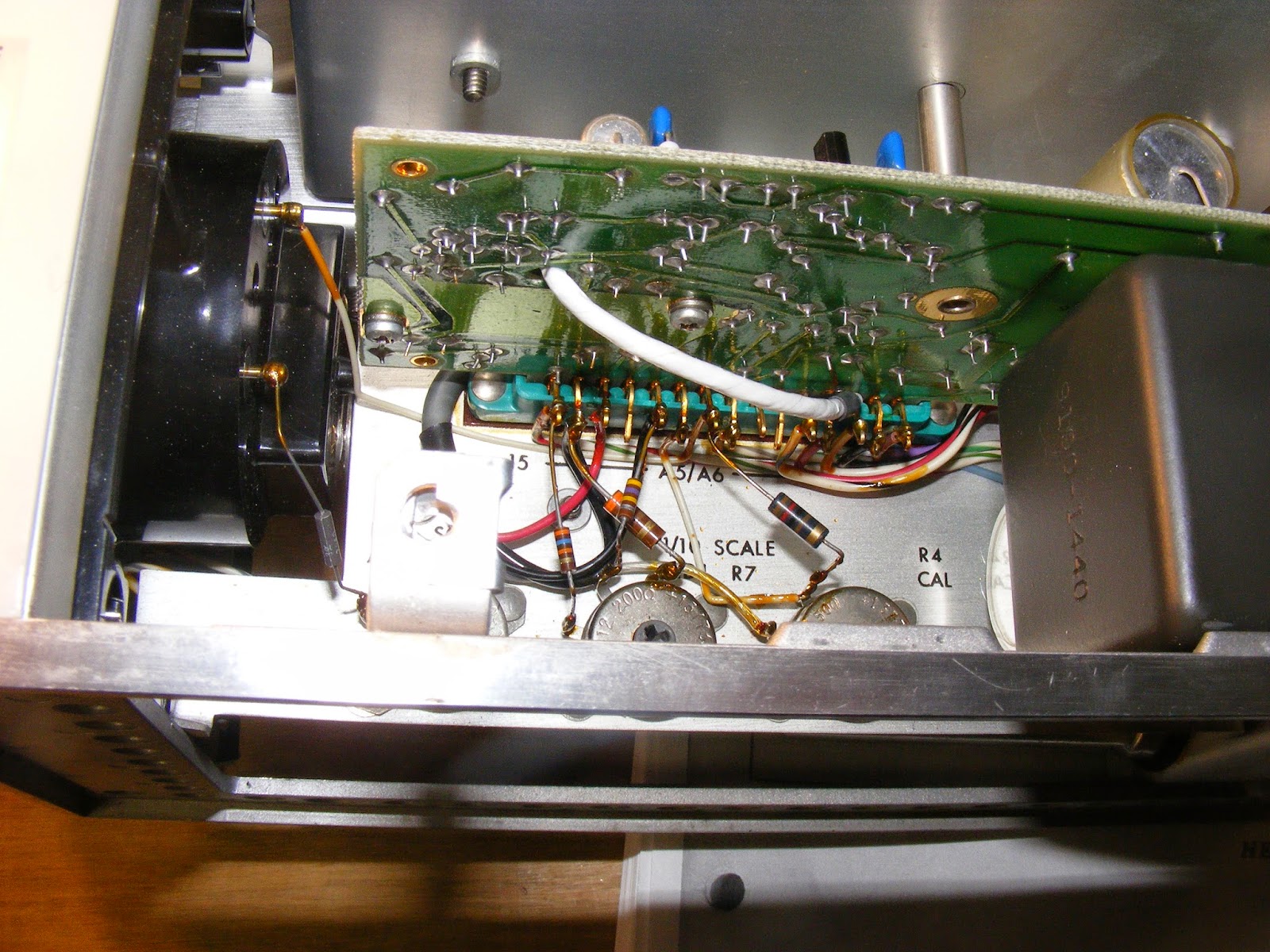
So, I blocked out a nice Spring Sunday late morning and afternoon to debug this beast, figuring it would take the whole day. What I discovered was that, once you got into it, the HP manuals really are understandable and their troubleshooting steps do make sense. Here are some photos of the guts in no special order, just to give you a sense of that's going on.

Ready to rock..

A4 Board with Thermocouples (TC401 and TC402)

Unit Range Switch

A2 board with Nuvistor

A6 Board Top View

A6 Board Ground Level

To cut this narrative short, troubleshooting involved tracing the signal from the input jack through the range switch, the A2 board and thence over to the A4 board and into the A6 board. The step-by-step guided me past the anticipated shoals of the A2 (nuvistor) and the A4 (with its thermistors) and intact onto the rocky beach of the A6. I was really concerned that the thermocouples had to be replaced but it was not to be.

Anyway, I poked around the A6 board and found that something was misbehaving. Glancing at my donor unit, I noted that its A6 board's photochopper/modulator/demodulator assembly looked entirely different than the DUT and I reasoned that parts swapping was probably not in the cards. After a break for lunch and gazing at the two units, it hit me that both A6 boards, while different, were plug-in units and, in a WTF moment, I swapped them out. (Well, I put the donor unit's A6 into the DUT slot)

Wham!

I fired the sick 3400 up and, after the warm-up mambo, it settled down and behaved like a well puppy! Follow-on measurements and a waltz through the calibration procedures yielded a unit that was shockingly accurate and reliable on all ranges, so much so, that it has now replaced my other 3400 as the official bench AC voltmeter.

What a joyful experience yielding a good unit and three free hours on a Sunday afternoon to play with my new toy and enjoy a couple of cold ones with the bride.

-30-