Tuesday, October 29, 2013

Signals, Set, 1..2..3..

I am skipping over the Ugly Weekender to post an effort last weekend that yielded some interesting results. Be advised that I am not abandoning it -- far from that -- I am only time-slicing while I gather parts. Also, I have a couple of other irons in the fire like putting the VTVMs to bed (a post will be up on that adventure shortly) and doing some fix-up on the NesCafe CW filter kit from NEQRP. (Ditto.)

When family, work, and the USAF Auxiliary allows it, I frivolously waste time on ham radio and electronics projects and, when doing so, I am in one of two modes: gathering projects at swap meets or building, fixing, or operating the treasures I haul in.

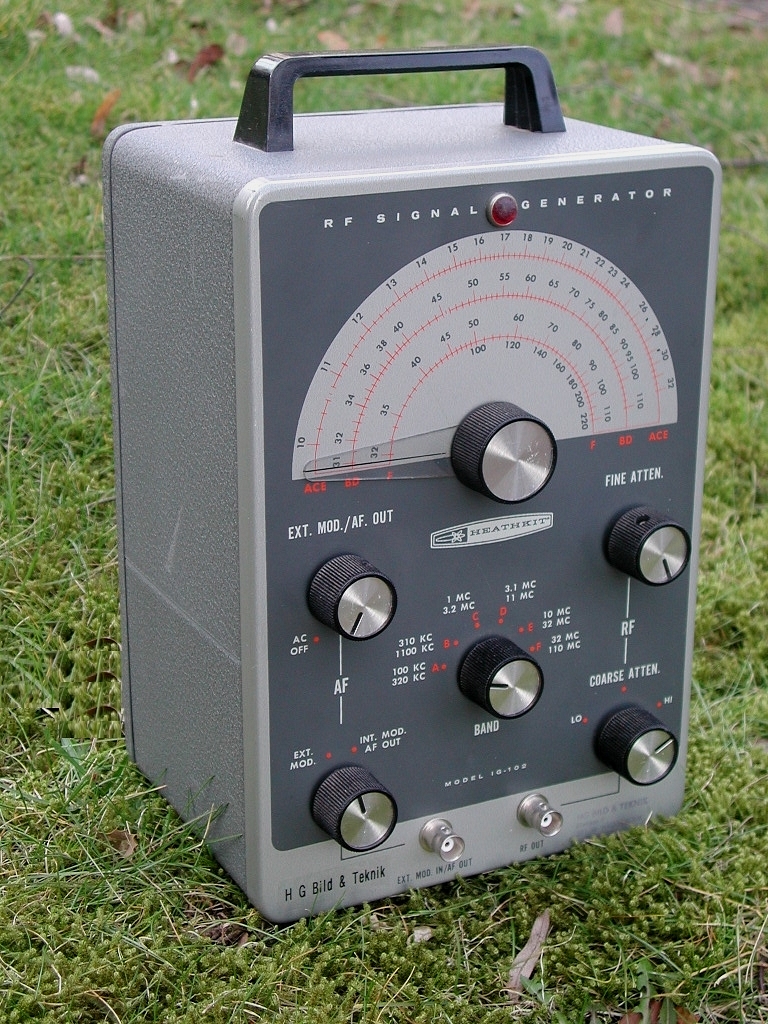
But, alas, my hunter-gatherer skills far outstrip my builder-operator skills and I have built up quite a backlog of these projects. To shame myself, I order my "acquisitions" into a FIFO list so that there is some throughput at least and the scenery in the workshop garage changes over time. Anyway, somewhere back in the past six months, I went on a jag and started accumulating Heathkit IG-102 signal generators. You know, these beasts on the left there. (For that matter, I always go on these jags. As Dennis Kidder, W6DQ famously says, "Why buy one of something when you can have two at twice the price?" The VTVMs were the result of such a bender.) I amassed three of these generators, two in good shape and one having no power cord and generally requiring more attention. Well, last weekend, as they were gathering dust on the shelf, I decided it was time to act and started in on refurbishing them.

Now, for those looking for a low-end signal generator at a reasonable cost, the IG-102 is a good one. It's about $35-75 (or more) on EvilBay or $20-50 (or more) at a local electronics swap meet. (I prefer the latter venue because of the cheaper prices and the fact that you can eyeball the product INSIDE and OUT.) Also, the fact that the entire manual can be found as a .pdf (think mods.dk) is a definite plus as the build "how-to" is definitely more informative than the troubleshooting chart in the back of the manual.


As for refurbishing the units, I rescued the two and breathed life into 'em in a far shorter time than I thought it would take. Initially, both did not produce any RF out whatsoever. So, after poring over the schematic for a while, I poked and prodded from where I thought the RF should originate and was delighted to find a signal. I proceeded to follow it to the RF out connector but I lost a little bit somewhere between the plate of the pentode side of the 6AN8 and the wiper of the fine attenuator pot. The rest of the RF fled on the input side of the course attenuator switch.

Judicious application of contact cleaner at various points on that path materialized the RF at the output connector and we were in business. One of the signal generators had a "lumpy" fine attenuator pot so I replaced it with a 10 KOhm one I had lying around. (The original was a 3 KOhm audio taper jobbie.) The 10K worked fine; it was a little tight but, with practice, I was able to set my signal level right enough.

The only problem was that I only had one set of tubes so I ordered another 12AT7 and 6AN8 off of eBay. Just to let you know, they ain't cheap and, surprisingly, the 6AN8 is a little more dear than it's cohort. If you want to rebuild one of these machines, budget another $20 for the tubes if yours are shot or missing. Also, here's a re-cap of the recommended debug steps:

(1) Don't hesitate to clean the switch contacts on the attenuator pot and the band switch (where the coils are).

(2) Trace the obvious signal path from the grid of the pentode half of the 6AN8 through the fine attenuator pot through the coarse attenuator switch. If you are using a scope, mind the DC on the plates of the tubes and such. There are convenient DC blocking caps where you can pick up the RF if it is available. One prime spot would be at pin 8 of the 6AN8 as I recall.

(3) You might find the fine attenuator pot "lumpy" -- it can be replaced by a 3 KOhm pot or a 5 KOhm one or even 10 KOhm pot -- which I used on my "keeper" unit.

(4) Replace those useless mic connector plugs on the chassis with BNCs. It's very easy to do and makes your unit more compatible with coax links you might have laying around.

The remaining unit of the trio lacks an AC power cord and will probably end up becoming "transistorized". I actually was going to do this with all three, except the first two work so great when refurbished, I did not want to go to the extra effort. (If it ain't broken, don't fix it.)

In any event, to convert this unit, I'll have to strip out the AC power supply and the tubes and replace the latter with a pair of MPF-102s each. When done, it will be powered by a 9V (or 12V) battery. Notes on the project (it came from the May 1978 73 Magazine) advise soldering the MPF-102s to the actual tube socket lugs underneath the chassis. But, I am thinking about getting some tube-pin-diameter copper wire and stick those into the appropriate tube socket pins and then wire the JFETs to the copper wire. That way, if I blow up a JFET, I can pull it and insert another.

Looking at the pin-outs and how one wires the drain, gate, and source, I surmise that the two JFETs will face each other and the pin-outs will be:

12AT7
FET #1 - 1=Drain, 2=Gate, 3=Source
FET #2 - 6=Drain, 7=Gate, 8=Source

6AN8
FET #1 - 1=Drain, 2=Gate, 3=Source
FET #2 - 6=Drain, 8=Gate, 9=Source

..but DOUBLE CHECK; I could be wrong!


I'll get back on this last project and post some pictures.

Thursday, October 17, 2013

Whooped with a ugly stick..


Jeff Tranter, VE3ICH, produces some of the best You Tube ham radio videos going. I absolutely love his style: polished, matter of fact, and everything is neat ~~ as in tidy, cleaned up, organized. Anyway, Jeff built Roger and Wes Hayward's "Ugly Weekender" transceiver as he shows you above. Of course, nothing Jeff does is ugly but you get the idea.

So I was doing a little research and found that there were PCBs -- by Far Circuits, of course -- and they were reasonable at about $13 for the set plus $5.50 shipping. So I tumbled for them and will see how this turns out.

Perusing the two Hayward articles reveals that the components required are surprisingly commonplace: a handful of 2N3904s, an MPF 102, and SBL-1, and an LM-386 audio amp. The rest are resistors and capacitors and easily-wound toroid coils and transformers. The circuits themselves are fairly prosaic (said the electronics whiz kid) with the MPF 102 VFO and a direct conversion receiver. However, there are some interesting features like semi-break-in, a frequency spotting mechanism, and sidetone.

Anyway, so there it is. Probably my next project, the first phase of which will be to roam through my "well-stacked" junk box (as Jeff Tranter describes it) and stuffing the parts into the boards -- or hoarding them and building it up in stages.

"Hmmmmmm, that broad sure has a well-stacked junk box!"
So there it is, too many notes!

-73-


Thursday, August 15, 2013

After the Gold Rush and the mid-seventies..

The confusion of a private high school in the San Francisco Bay area (football,girls, soccer, track and field, girls, Summers in Massachusetts, and yet more girls) served to relegate my amateur radio endeavors to the back burner. This state of affairs continued on into college at UCLA (and now surfing and yet more girls) and thence to the U. S. Air Force and a grim four years at Strategic Air Command in Bellevue, Nebraska.

Ironically, one of my good friends while in the Air Force was Captain Don McMinds who held WA0LGS at the time, I believe. (He is now K7DM and lives in Ocean Shores, Washington) But even Don's ardor for amateur radio could rouse me from the dreariness that was Nebraska so I spent four years in a location where I could have had an awesome antenna and a robust ham station and the wherewithal and time to operate some righteous DX.

It was pretty much the theme for me around that time: I eschewed opportunities to develop my running (I was to become a marathoner in the late Seventies), my cycling (a bicycle racer in the Nineties), and various other things, ham radio among them. Pretty much spent those years feeling sorry for myself.

That said, I returned to Southern California and began the desultory prospect of wresting my daily crust maintaining civilian software systems. Let's face it, deriving war plans and telling B-52s where they should deliver their megaton gift packages relegates accounts receivable and payroll programs a distant second.
Largely by dint of an argumentative conversation with some young German double-E asshole at a cocktail party, I got this chip on my shoulder. I was bragging about a Nordmende short wave radio I had just acquired and tried to one-up the kraut prick by telling him I was once a ham radio operator and wanted to show him up so, the next day, I set out to revive my amateur radio adventures. Discovering that the local JC offered a course, I enrolled at Orange Coast College and and acquired WN6EPZ -- a two-year, non-renewable Novice ticket.

My dad then presented me with a nice, shiny Kenwood R-599. It was actually one of two he bought at the old Henry Radio store in Anaheim. Seems he got a discount deal on the pair. When the ticket came (we waited for them in the mail in those days), I went up to the other Henry store (in Santa Monica) and, with the help of a very nice salesman, I scored the receiver's mate and thus ended up with my twins. Somewhere, I managed to scare up an S-599 speaker as well. The picture at the left is NOT my station, but it's close. 

These along with a Hustler 4BTV served my purposes during the two years as a Novice and I worked a lot of CW on 40 and 80 meters. My memories stray to one early rainy morning session where I worked Virginia, Washington state, Hawaii, and Antarctica consecutively! Talk about a demonstration of how omnidirectional verticals are!

Sadly my license expired and, owing to a move to another nearby residence to accommodate my second son's birth and my upwardly mobile income, I did not devote time and effort to move on to a General class ticket. However, in 1978, when asked by a client to babysit a software system I had just installed in their factory, I took advantage of the opportunity. They said they didn't care what I did -- I could even bring in Playboy and read it all week if I wanted to -- as long as I was immediately available. So, doing the next best thing, I brought in the ARRL license manual, studied all week and, when they gave the Friday morning off, I went down to the FCC office and sat for the Novice/General combination (75 questions) and scraped by the 13-WPM code test by the skin of my teeth.

Remembering the advice of my JC course ham instructor, I also sat for the Advanced license: same code test (already passed) and 50% more HF spectrum. When the FCC examiner said I missed thirteen questions (out of fifty) I was crestfallen -- until he reminded me that was a passing grade. Walked out of the office on a cloud and resolved to come back a year later and take the Extra. (It was actually almost two decades later that I did so.)

The really cool thing about an Advanced Class license in those days was that it earned one of those sexy 2x2 call signs. So, three weeks later, when my ticket arrived pronouncing me as KB6HK, I jumped on 20 meters CW with the twins and worked a few Qs. It was amazing to have a wall of folks come back to you thinking that you were on Baker or Howland Island. When I gave out my QTH as Huntington Beach, California, the traffic faded away like dew in the morning sun.


Somewhere along the line, I wanted to have everything "in one box" and dealt away the twins for a brand new Kenwood TS-520S and started working a lot of 80 and 20 meter phone. All in all, I loved the 520 from the day I bought it. It was one of the first times that I actually took my (then) younger son, Erich, along with me. He was about three years old and heretofore had only ridden with either his mom or the both of us. But this time it was just dad and son and the only downside to that was that he was a little young to understand the thrill of picking shopping for ham radio equipment. When we got to the store, however, I made sure Erich had a lot of time to press the buttons and play with the toys. (Strictly supervised, of course.) To hear him tell it today, he liked the adventure.  

Also, the neatest thing about the 520 was that I could port it downstairs, set it up on the patio, drive a post into the grass and use a piece of 11-foot EMT conduit as a 15 meter vertical. I managed to work all over the Pacific those lazy Sunday afternoons -- Australia, New Zealand, and Japan.

Life was great!

(It was about this time that I also got into VHF FM -- brand new to us back in the late 70s -- and will chronicle the great VHF and UHF rigs I owned/built in a separate post.)

-72-

Wednesday, August 14, 2013

Memorable (or not so memorable) Radios..1961..

I remarked to a friend on a Yahoo Group the other day that, in reality, two of my fondest wishes would be to have (1) sufficient wealth to purchase and keep all of the radios I bought over the course of my amateur radio years and (2) to have a shack big enough to stable them all.

Let's face it, we may not be geniuses but we ain't that stupid either. Like me, certain sure you have hauled in some real dogs from a swap meet and, after twiddling the dials and putting out a few calls, you realize that, while your little treasure works just fine, it ain't making it into your rig hall of fame.

Nossir!

I thought I'd make an entry here and post some of the goodies I have owned and some of the dogs as well. Consider it a work in progress and a labor of love. Here we go.

Where to start? Well, some radios in my past put an emotional tug on the heart strings. The melancholy is intertwined with the richness and promise of my (relative) youth, my two sons, and the circumstances in which I was forced to part with them. (The radios, not my sons.)

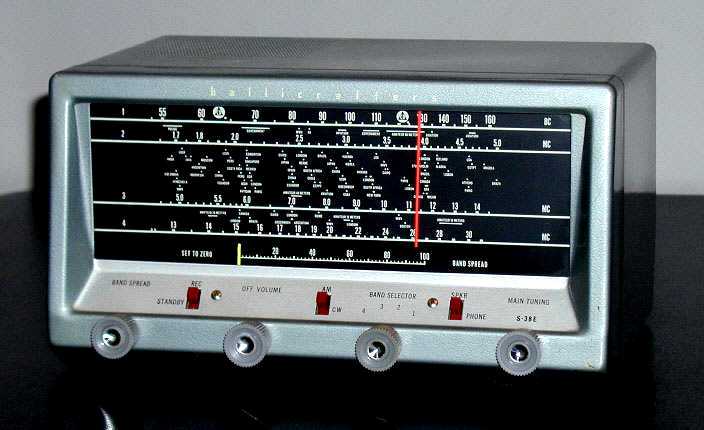
I was first licensed in 1961 as a Novice (one-year, not renewable) and received the call sign WV6KJK. (Wholly unmemorable; definitely not a keeper.) I still have that shred of paper -- hand signed by C. B. Plummer -- along with other fragments of that pre-high-school period including my Vibroplex bug and some no-so-fond memories of my Heathkit DX-40 and Hallicrafters S-38E receiver. I also built up a Heath VF-1 but never used it because we were required to be crystal controlled. I remember my crystal crystal
frequencies: 3,720 Mc, 3,730 Mc, and 3,740 Mc for 80 meters and 7,196 Mc and 7,198 Mc for 40 meters. (I think I still have a couple of the 80 meter crystals.)


But nothing in that setup tugged at my heartstrings and I worked no memorable DX (unless you consider Castro Valley from Woodside, California. And, I want to go on record as saying that the Hallicrafters was THE WORST receiver a young, aspiring ham could have.


About the only thing that can be said about that era was my dad's generosity: he bought
me the receiver and the DX-40 which came as a kit, so I built my own. In fact, dad (at that time a former ham) also sprung for the VF-1 kit, a Heath O-Scope and signal generator kits.

As desultory as my ham radio efforts int those days were, my father's kindness planted the hook firmly. After high school, college, and the U. S. Air Force, I was destined to return with a vengeance.

-72-


Wednesday, August 7, 2013

From Vade Nitram..

Think about it..


Monday, May 13, 2013

For my personal reference..

I inherited (for a pile of greenbacks) a really mint Tek 485 and wanted to check it out so I came up with these videos courtesy of this really nice guy (who sounds eerily like Gomer Pyle).


He does a pretty job of explaining and demoing this feature. I post it here as a convenience for myself. There's also this video on how to check one of these beasts:


..and some more:


Enjoy; I shall.

-73-

Wednesday, May 1, 2013

Idiom Press SCAF-1 Wars: My own fresh hell continues..


Well folks, I was forced to capitulate. The guy at Idiom Press still yet again continues to ignore my pleas for information. I was lucky to have scooped up one from my good friend and mentor, Dick, WB6JDH, and "opportunities abound". (See below.)

But to close off this little chapter of my own fresh hell, I cancelled my order with Idiom Press and told them that I was not going to be joining their fan club anytime soon. Closing the loop, I published the following review on eHam.net:
I am compelled to weigh in with a less-than-sunny evaluation of this product. I had written a previous review (removed by eham.net) based upon my experiences with the Idiom Press people and their failure to not only not deliver their product BUT TO REFUSE TO ACKNOWLEDGE MY ORDER AND RESPOND TO E-MAILS AND PHONE CALLS OVER A SIX-WEEK PERIOD. (I was not alone in travails like these; another ham had similar contemporaneous problems and likewise cancelled his order.) I can understand the previous review being removed because it was not about the product per se.

Anyway, aside from the fact that I did not have my order honored and ultimately cancelled with them, I bore the actual product no malice. In fact, because I was able to pick up one at a swap meet -- one requiring repair work, by the way -- I want to now write of my experiences and offer caveats to anyone contemplating purchasing the product or the kit. Here goes:

Firstly, the unit I got at the swap did not work. Attempts to find a manual were fruitless until a fellow ham graciously sent me a copy of his. Upon commencing the repair work I noted that there were radical differences between the manual and the actual unit I had on hand. While the board may have been accurate per the manual, the front switch was not. My unit had a DPDT with six tabs and the manual had nine tabs. The wiring on the unit I had bore only the remotest resemblance to the wiring in the documentation.

Please note that the instructions were published in 2006 and there was an addendum of corrections outlining a means of modifying the LM386 circuitry so it would perform better. (I think circa 2008) It was a very complex series of "four instructions up from the bottom change x to y" steps and occurred to me that perhaps the owner should have REWRITTEN the original to reflect the changes and tied them more tightly to board/kit revisions.

When I finally got my unit working, I was pleased -- BUT ONLY MILDLY IMPRESSED -- with its performance. The circuit is merely a low pass filter comprised of the two SCAF chips driven by a 555 timer. It ain't rocket science. Frankly, the NEScaf kit by the New England QRP club (http://newenglandqrp.org/nescaf) and the HI-PER-MITE (http://www.4sqrp.com/HiPerMite.php) offer products with as much promise, are very well supported, and are much more reasonably priced than the Idiom Press SCAF-1 unit.

Finally, previous "I bought mine several years ago, built it, and love it" reviews might be nice and fuzzy and heartwarming but you will be spending anywhere from $95 to $130 for one of these things and, if so, you had better be prepared for

(1) At least six weeks of being ignored after your order is taken.
(2) The prospect of a kit whose instructions are ambiguous and possibly out-of-date.
(3) A pathetic record when it comes to support and service.

The 2 is for the performance of the unit. Were I to rate the overall experience with Idiom Press with respect to the SCAF-1, it would be zero.

Color me unimpressed.

The Adventure Continues
That said, Dick's unit -- that he graciously sold to me and that was working when he did so -- went South when I began to operate it around the shack. It performed (as I said in the review) adequately but I was not screaming and the Earth did not move for me. I would rate it a so-so and look more eagerly to buttoning up my Hi-Per-Mite and NeSCAFe filters since they are documented better and seem to perform AS WELL AS the SCAF-1. Actually, truth be told, I am casting about for a really, really sexy container for the Ramsey AF-1 -- it performs very well but cries out for a better looking home.

Though my "Filter Days" are coming to an end (I have learned a lot and have several units that will make the various receivers sound good), I will get Dick's SCAF-1 working (with Dick's help of course) since there are the following unexplainable anomalies:
(1) The two Zener diodes to derive the +5V and -5V display run hot (very hot!) when a phone jack is plugged in the back and 12.5 VDC is applied.

(2) The unit does not work (i.e., complete silence) when powered by 12.5 VDC and switched on. See above regarding hot Zeners.

(3) The unit will not work with the right rear PCB mounting screw put in place and tightened down. It's intermittent. Again, see #1 and #2 above. This also happens when the box lid is mounted.
Now, I have no Earthly idea why all of this happens (which is why I am going to WB6JDH's QTH Saturday) but, when I find WB6JDH finds out, I will write it down here.

Breaking News!
I have discovered why the Zeners heat up and it'll surprise you. It is a fundamentally BAD DESIGN. I write the following to Joe, K3JLS, and let it serve as a warning to you if you are contemplating the purchase of one of these units:

Joe:

Just a word to let you know that there is a potentially serious bug (thank you for the schematic and manual) on the SCAF-1. It will not affect 99% of the people who use it, but it bit me in the fanny.

As you know there are two grounds in the unit. One is the power supply common ground and the other is the "artificial ground" in the circuit to derive the +5 VDC and -5VDC voltages for the chips. Turns out, if you have a common power supply for your SCAF-1 and your HF rig, then the two grounds on the SCAF-1 touch pee-pees and cause the voltages to get all hosed up and the Zeners to get hotter than blazes.

It affects my station because I use an Astron RS-20M to drive my IC-745 *and* the SCAF-1.

First noticed it when I was researching why the board seemed to have "microphonics" when I buttoned up the board and put on the cover. At the risk of boring you to distraction, I kept the cover off when I was testing it in the station and noticed every time I plugged in the station PS,that the unit stopped working and the Zeners began to sizzle. I then powered it with a separate gel cell and everything worked fine.

Also, my unit was one built by one of my SK friends and it had 4-40 screws from the chassis to the board which -- after a little abrasion -- shorted the two grounds together. So I replaced them with nylon screws to avoid any problems.

Probably obsessing over this, but would not feel right if I did not inform you. Oh, and I am NOT a EE but I got a friend who is [one and is the smartest ham I know when it comes to fixing things: WB6JDH] and he confirms [my analysis].
So, the bottom line is that common ground problem exists for anyone who buys the SCAF-1. Also, here's a tidbit: the SCAF-1 circuit was ripped off a 1995 QST article (reference upon request) that has a Far circuit board made for it. I was gonna get that but, now that I know the dual-ground problem, I think I'll live with my other swap meet treasure -- the Ramsey AF-1 -- and that should be fine. Besides, can you imagine a company propagating a circuit error like that? (But it does beg the question as to why this problem has not been discovered before.)

Besides, I have to build the upscale version of Lou's noise bridge.

..so many kits/projects, so little time.

-72-